
Planungsluecken
Kundenanforderungen werden nicht konsequent in messbare CTQs und Kontrollstandards uebersetzt.
QMS4.0
Eine Plattform fuer das gesamte Qualitaetsmanagement in der Fertigung. Sie verbindet Kundenanforderungen, Qualitaetsplanung, Pruefung, Audit, Reklamation und 8D-Verbesserung auf einer gemeinsamen Datenbasis.
Typische Probleme
Wenn Audits, Rueckverfolgbarkeit, Lieferantenarbeit und mehrstufige Pruefung auf verstreuten Tabellen basieren, steigen Verzoegerungen, fehlende Nachweise und Wiederholfehler.
Kundenanforderungen werden nicht konsequent in messbare CTQs und Kontrollstandards uebersetzt.
Wareneingang, Prozess, Endpruefung und Ausgangspruefung sind schwer zusammenzufuehren.
Verantwortliche, Termine und Status sind in Dateien und Chats schwer sichtbar.
Meldungen, Sonderfreigaben und Bewertungen beruhen oft auf manueller Nachverfolgung.
Ursachen werden gefunden, aber Massnahmen erreichen FMEA und Kontrollplan nicht.
Kalibrierung, MSA und Qualifikationen werden erst kurz vor dem Audit zusammengesucht.
End-to-End Loop
Seven connected stages are supported by system modules. Data flows across stages without repeated manual entry.
Current stage
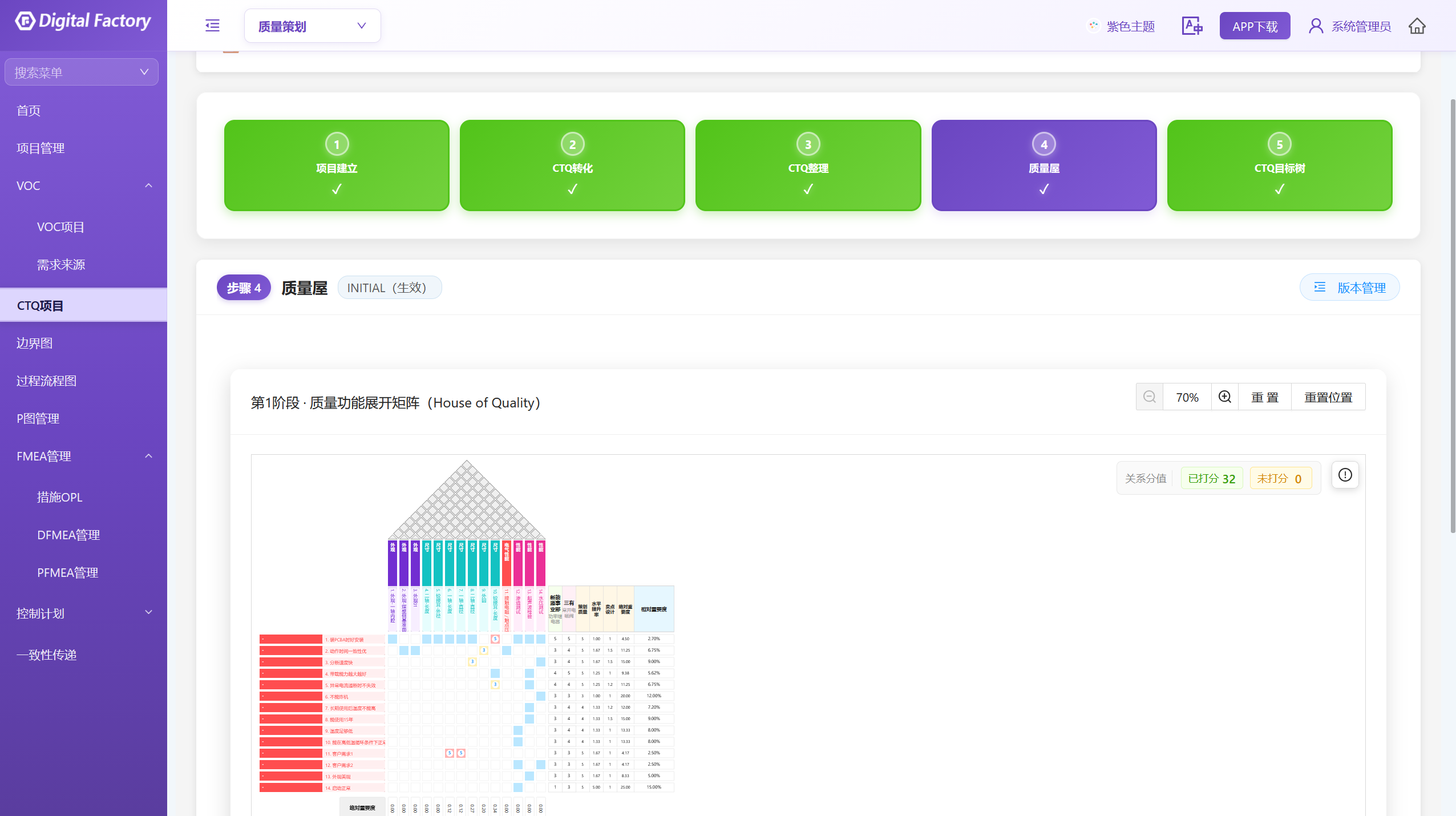
VOC / CTQ projects
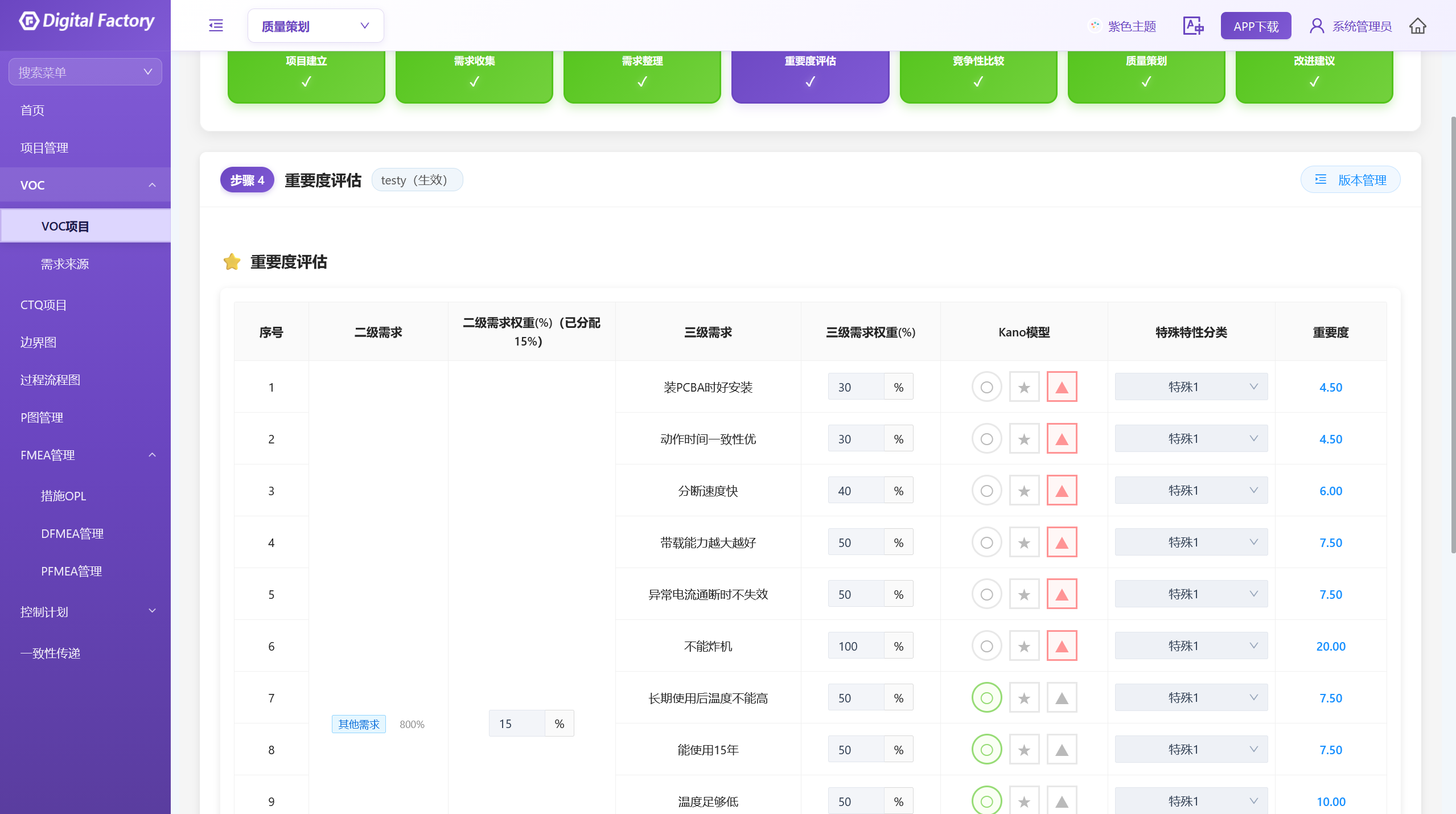
Capture voice of customer, build requirement trees, evaluate importance and translate needs into measurable quality characteristics.
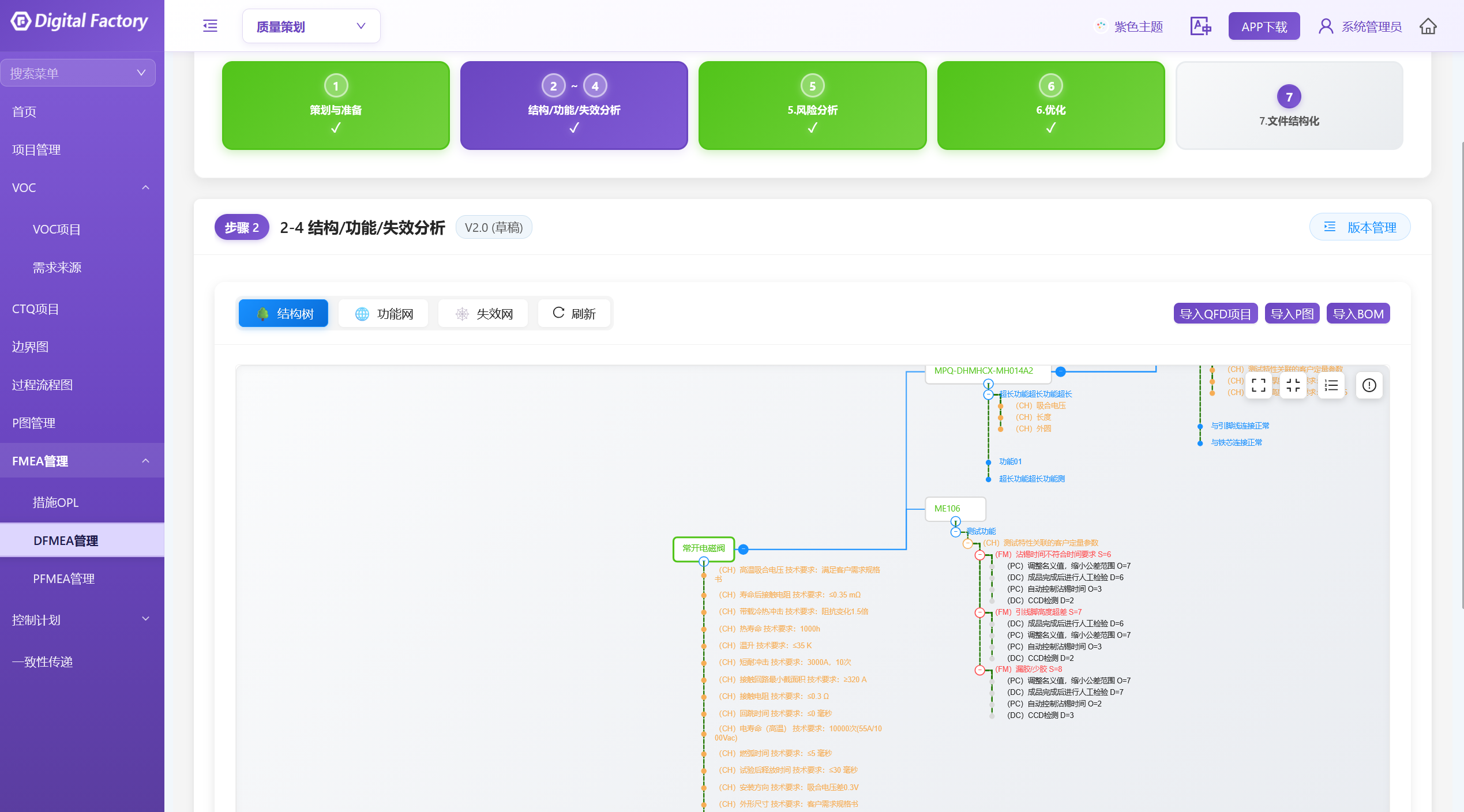
The conclusion of improvement returns to risk prevention. 8D preventive actions can update FMEA, control plans, inspection plans and OPLs to prevent recurrence.
Five Modules
Unified defects, characteristics, failures, methods and evaluation rules keep planning, inspection, audit and 8D speaking the same quality language.
Positioning
Typical scenarios
New product launch, customer requirements, design review, pilot to mass production
Scenario Walkthrough
Each walkthrough shows what happens in daily quality work and which modules are connected.
Current walkthrough
Modules involved
Quality Planning → Process Quality
Create one project foundation for VOC, CTQ, DFMEA and PFMEA.
Collect VOC and classify needs with Kano and importance scoring.
Translate CTQs into product characteristics and quality targets.
Build process flow and link characteristics to processes.
Use DFMEA/PFMEA outputs to generate control plans and PPAP deliverables.
Suitable for: New product launch and pilot to mass production
Platform Capabilities
PC supports planning and analysis, while mobile apps support field inspection and photo upload.
Dashboards show inspection progress, personal performance, supplier performance and bottlenecks.
AQL, transfer rules, exemption rules, timeout alerts and escalation mechanisms are structured into tasks.
Recall approvals, 8D PPT export, inspection data export and image recognition templates support field work.
Cross-module permissions, version management and structured audit trails support quality system audits.
Defects, characteristics, failures, measures and criteria are centrally maintained.
Value
QMS4.0 reduces repeated maintenance of scattered forms by connecting quality planning, inspection, gauge management, audits, complaints, recalls and 8D improvement.
VOC → CTQ → Control plan is connected with versioned downstream delivery.
Automatic rules, mobile reporting and structured records reduce manual errors.
Owners, deadlines and progress are visible with timeout alerts and escalation.
Calibration, MSA, qualification, audit and inspection records are archived continuously.
Sprechen Sie mit den Qualitaetsexperten von LinkedData und sehen Sie, wie QMS4.0 Planung, Ausfuehrung und Verbesserung verbindet.